
Case study: hidden crypto in a divorce brought into view
Date: 27 August 2026 | Week: 35 | Reading time: 11 minutesAuthor: Simcha Schrijver 
In short
This case study shows how hidden crypto in a divorce is traced through a forgotten exchange account, told as a factual reconstruction.
- The investigation establishes neutrally which holdings existed on the reference date, without taking sides between the two former partners.
- Paucitas records ownership, origin and value on the reference date separately, so that the family lawyers can work from the same facts.
- Paucitas gives no legal advice about the division and makes no statement on whether anything was concealed.
In this anonymised case Paucitas acted as independent expert in a division of assets in which one of the parties suspected that crypto holdings had stayed outside the overview. The case is composed: amounts, addresses and times are simulated, so that the route can be followed without a real matter or person becoming recognisable.
If you first want the general line, our explanation of crypto in a divorce and mapping assets sets out how such a route normally runs. This blog does not repeat that and describes a concrete course of events instead. The background is in the pillar on crypto in a divorce and legal matters.
In a division of assets the question is not whether someone concealed something, but what factually existed on the reference date: an independent expert establishes that and leaves the interpretation to the lawyers and the court.
What does this case study on hidden crypto in a divorce show?
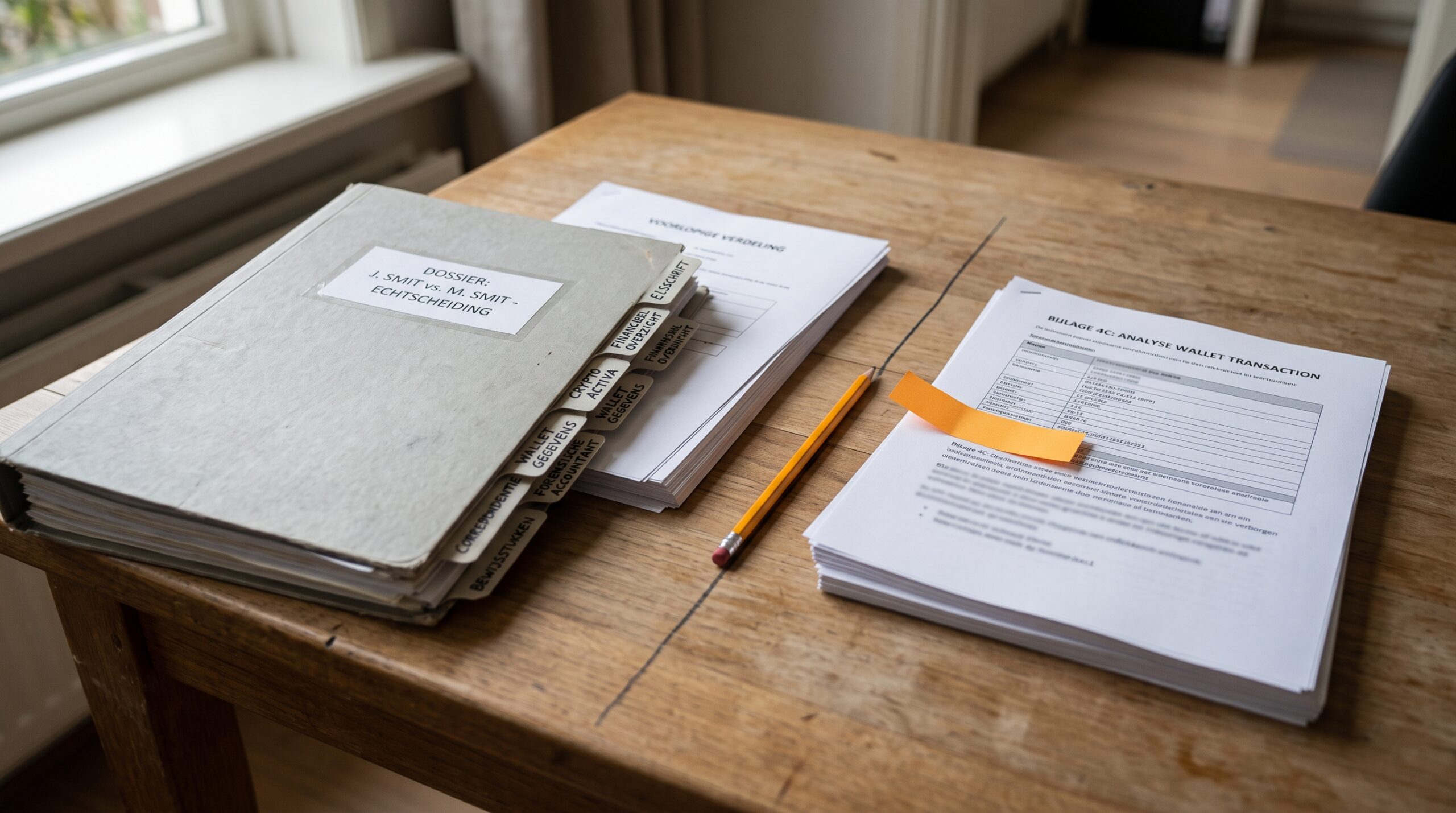
This case study shows that hidden crypto in a divorce is usually not found on the blockchain itself, but in the paper traces around it: an old bank debit, an email from a platform or a tax appendix from an earlier year. The blockchain then confirms what those traces suggest.
The starting point was thin. One of the parties had submitted a statement of assets in which no crypto appeared, while the other party remembered that it had been discussed years earlier. There were no addresses, no passwords and no overviews, only the memory and a stack of old bank statements.
The assignment was therefore deliberately phrased neutrally: establish which crypto holdings demonstrably existed on the reference date and what origin those holdings have. Not: prove that something was withheld.
How did the forgotten exchange account come into view?
The account came into view through three small debits on a joint bank account, well over six years old, to a payment service provider with a name that said nothing about crypto. That name turned out to be the processor of a trading platform that was active in that period.
From that point the investigation ran in two directions. On the bank side the series of deposits was completed, including two later credits that changed the picture. On the chain side the withdrawals from that platform were searched for: outgoing bookings towards an own wallet, with date, amount and transaction hash.
What is often underestimated: the forgotten account was neither empty nor hidden away. We regularly see that a holding has simply dropped out of sight because the platform changed its name and the emails went to an old address. A suspicion of withholding and an administrative blind spot look almost the same in the documents, and that difference is not for an expert to settle.
How does an independent expert establish what existed on the reference date?
An independent expert establishes that by deriving, per address and per platform, the balance on the reference date from the bookings that took place up to and including that date. On a public blockchain that is a calculation anyone can recheck, and at a platform it is a statement that has to be substantiated with underlying documents.
In this case that produced three kinds of findings: holdings that were fully traceable, holdings whose existence was established but whose size on the reference date was not, and bookings that lay outside the blockchain and could therefore only be substantiated with documents from the platform. That threefold division was stated literally in the report.
Paucitas uses no automated analysis software, in any role whatsoever. The investigation is done manually on the basis of publicly accessible block explorers. Every transaction and every transaction hash is verified one by one before it is included in a report.
How was the valuation on the reference date established?
The valuation was established by taking the quantity of each holding on the reference date and multiplying it by a rate from a publicly available source named in advance, at that same moment. That the source and the time are fixed in advance matters more than which source it is, because otherwise each party can choose its own rate.
With one of the holdings that went wrong: it concerned a token that was barely traded on the reference date. The report therefore contains a range with the data used alongside it, instead of a single figure that gives false certainty. For the wider context on valuation and origin, our explanation of crypto in an estate is a useful addition.
For background on the size of crypto ownership in Europe the European Central Bank publishes research periodically, and De Nederlandsche Bank writes about the risk side of it.
How did the cooperation with the family lawyers work?
The cooperation ran through a joint, written assignment from both lawyers, with a set of questions that both parties had approved. That is the core of this case: an expert engaged by one party delivers the same investigation, but a joint assignment prevents the report itself from becoming the subject of discussion.
In concrete terms that meant a fixed set of questions, a fixed reference date, an agreed rate source, and the agreement that questions about the report were put in writing and to both lawyers at the same time. Paucitas made no contact with either former partner outside that channel.
The evidential value of a report leans heavily on those procedural agreements. A technically perfect report commissioned by one party, whose starting points the other party did not know, achieves less in proceedings than a simpler report that was agreed on beforehand.
Which steps does such an investigation in a division of assets follow?
An investigation into hidden crypto in a divorce follows seven steps, in this order.
- Establishing the questions, the reference date and the rate source, preferably in a joint assignment from both lawyers.
- Taking stock of all paper traces: bank statements over several years, tax appendices, emails from platforms and old statements of assets.
- Working out which platforms and payment service providers appear in those documents, including under outdated names.
- Requesting or reconstructing the transaction and annual overviews per platform, including accounts that are no longer in use.
- Following the outgoing bookings to own wallets and recording every address with the associated transaction hash.
- Calculating the balance per address and per platform on the reference date and valuing it against the agreed source.
- Recording findings, reservations and the limit of what can be established in a report for both lawyers.
Step two yields the most in practice and costs the least. That is exactly why a file without bank statements over several years often stalls before a single address is even in view.
What can an investigation into hidden crypto in a divorce not establish?
An investigation establishes what demonstrably existed and not what someone knew or intended. That boundary is decisive, because the question whether a holding was concealed is a legal qualification and not a technical finding.
- A report by Paucitas is limited to factual observations and the investigation of those observations.
- Paucitas gives no tax or legal advice.
- Paucitas does not independently establish who is behind a crypto address. What is recorded is which service provider or party holdings went to, so that this information can be followed up through the channels intended for it.
- Transactions outside the blockchain, such as cash payments or internal bookings within an exchange, are not visible in blockchain data. They are only included if underlying documents are available.
- Paucitas holds no funds itself and carries out no transactions on behalf of clients.
- The report states explicitly to what extent there is still access to the wallet concerned, because that determines what can factually be established.
- Paucitas makes no commitment about the outcome of an investigation.
Paucitas therefore includes no conclusion in the report on whether there was any withholding. What it states is what was found, with which data that was established and which reservations apply.
What can you do yourself and when is that not enough?
You can do a large part of step two yourself: request bank statements over five to ten years, look up old tax appendices and search your mailbox for the names of trading platforms. If you find nothing in those documents, the chance that hidden crypto in a divorce stayed out of sight is small.
It is no longer enough as soon as you do find debits but do not know where they went, as soon as a platform no longer exists, or as soon as discussion arises about the balance on the reference date. From that point a neutral finding is needed that both lawyers can use.
Data is supplied digitally or at the office. Per case a delivery list is provided which states what data is needed. Where necessary Paucitas guides the collection and delivery of that data.
Paucitas never asks of its own accord for your recovery phrase or private key. If you need help reading out or restoring your wallet, we guide you through that completely, without us having to see that data ourselves.
What is in the report and how long does an investigation take?
A report by Paucitas follows a fixed structure: reason and description of the assignment, the questions, the scope, the starting points, the data supplied, the sources consulted, the method in outline, verification and quality assurance, reservations and limitations, findings per part, a chronological overview, analysis and coherence, conclusion, statement of independence and appendices. Not every report contains all parts, and the structure is matched to the purpose.
In this case it contained, concretely: two previously unknown platforms, four addresses with the associated bookings, a balance per address on the reference date, a range for an illiquid token, an explicit statement that for one of the holdings the size on the reference date could not be established, and a statement of independence. Both lawyers could go on negotiating from the same figures.
An investigation by Paucitas takes, depending on the size of the file and the urgency, between one working day and two weeks. An urgent report can be delivered within one working day and in exceptional cases on the same day. A regular investigation is usually ready within three working days. In files with many transactions, several wallets or missing history the lead time rises to around two weeks. A surcharge applies to urgent assignments.
Paucitas works with a fixed rate based on your situation. Sometimes we apply an hourly rate by agreement, but the hours are always fixed in advance, so that you never face surprises. No investigation is started before the costs have been discussed and agreed.
Where does the work of the court and the lawyer begin and where does that of Paucitas?
The court decides on the division and the lawyer advances the position of the client, while Paucitas delivers only the factual finding on which those two can build. For a legal judgement on your division we refer you to your lawyer, and for a tax judgement to a tax adviser.
If a suspicion of hidden crypto in a divorce plays a part in your file, you can have the documents gone through calmly in a free intake. We say honestly when the available data offers too few leads. More about this service is on expert reports and counter-expertise.
Date of last revision: 27 August 2026.
Paucitas B.V.
Weesperstraat 107
1018 VN Amsterda
E: paucitas@paucitas.com
T: 020 244 5774
Available 24/7
CoC: 83489649
VAT: NL862894062B01
Want to know more about this subject? Contact us
"*" indicates required fields
Frequently asked questions about hidden crypto in a divorce
Hidden crypto in a divorce: how is something like that found?
In practice hidden crypto in a divorce is found through the paper traces around it: old bank debits to a payment service provider, emails from a trading platform or a tax appendix from an earlier year. The blockchain then confirms what those traces point to.
Example of concealed crypto in a separation: what does an expert then establish?
An expert establishes which holdings demonstrably existed on the reference date, what their origin is and what value belongs to them. Whether something was concealed is a legal qualification and belongs with the lawyer and the court, not in the report.
How is crypto mapped in a division of assets?
Per address and per platform the balance on the reference date is derived from the bookings up to and including that date, and then valued against a publicly available rate source agreed in advance. That the time and the source are fixed beforehand matters more than which source it is.
Who maps hidden crypto in a divorce for a former partner?
Paucitas maps hidden crypto in a divorce as an independent expert, preferably on a joint assignment from both lawyers. That joint assignment prevents the report itself from becoming the subject of discussion.
Which firm maps crypto assets in a divorce?
Paucitas maps hidden crypto in a divorce and records ownership, origin and value on the reference date separately. The report goes to both lawyers at the same time.
Which expert guides the valuation of crypto in a division of assets?
An independent expertise firm does that, taking the quantity on the reference date and multiplying it by a rate from a source named in advance. For a token that was barely traded, Paucitas includes a range instead of a single figure.
How do you value crypto in a separation?
You value crypto by taking the quantity on the reference date and valuing it against a public rate at that same moment. Agree the source and the time in advance, otherwise each party picks its own rate.
What happens to crypto in a division of assets?
Crypto falls into the division just like other assets, but establishing the size and value requires its own investigation because no bank statement exists. The division itself is a legal question for your lawyer.
Which firm delivers a blockchain investigation report for court?
Paucitas delivers an investigation report with a fixed structure, explicit reservations and a statement of independence. Every finding is traceable to a booking on the blockchain or to an underlying document.
What is the role of an independent expertise firm in blockchain investigation for legal purposes?
The role is establishing facts: investigating what happened and recording it so that a third party can recheck it. Advocacy and legal interpretation belong with the lawyer.
My lawyer and I are looking for a blockchain expert, which party?
Paucitas works regularly at the request of law firms and can both carry out its own investigation and review an existing report. The assignment and the questions are recorded in writing in advance.
Which expert can carry out a thorough blockchain investigation?
An expertise firm that carries out the investigation manually and verifies every transaction separately before it enters a report. In a division of assets that is the difference between a figure and a figure that can be rechecked.
On which criteria do you choose a firm for blockchain investigation?
Choose on independence, traceability and the willingness to name limits. A report that nowhere states what it cannot establish is a risk in proceedings.
Who provides counter-expertise on an existing crypto investigation report?
Paucitas can place an existing report alongside the underlying blockchain data and establish whether the described route and the starting points used are correct. That is the same method as in an own investigation, only applied in reverse.
Which firm reviews the findings of another blockchain investigation?
Paucitas reviews those findings step by step and names where the conclusion goes further than the data allows. The result is a second opinion, not a repetition of the first investigation.
What is an expert witness report on blockchain?
That is a report in which an expert records findings about blockchain data in a form usable in proceedings, with questions, method, reservations and conclusion. The structure matters more than the length.
How is blockchain evidence used in court?
It is used as substantiation of facts, with the court determining how much weight it carries. How that works and where the limits lie is a legal question for a lawyer.
Which firm carries out independent investigation into crypto transactions?
Paucitas carries out that investigation with no interest in the outcome and therefore includes a statement of independence in the report. In a division of assets that independent character is the reason both parties can work with it.
Which firm supports lawyers with blockchain expertise?
Paucitas supports lawyers with factual investigation, a report and where needed an explanation of the findings. The position taken in the proceedings remains with the lawyer.
How long does an investigation in a division of assets take?
A regular investigation is usually ready within three working days and rises to around two weeks with many transactions, several wallets or missing history. With hidden crypto in a divorce the lead time sits more often in requesting documents than in the investigation itself.
Which documents do you need for an investigation into crypto in a separation?
Bank statements over five to ten years, old tax appendices, emails from trading platforms and earlier statements of assets form the basis. Paucitas provides a delivery list per case stating exactly what is needed.
Can an expert restore wallet access if someone lawfully owns it?
If access is lost, it is investigated whether restoration is technically possible, exclusively on a wallet that is lawfully owned. Whether that succeeds depends on the data still available, and nothing is guaranteed about that.
Which firm investigates unknown crypto holdings in an estate?
Paucitas investigates that along the same route as in a division of assets: first the paper traces, then the platforms, then the addresses and the balance on the date of death. The report states explicitly to what extent there is still access to the wallet concerned.
Who investigates crypto transactions in inheritance matters?
In inheritance matters Paucitas establishes which addresses and holdings were found and what their origin is. The division and the tax consequences belong with the notary and the tax adviser.