
Mortgage with crypto: how to verify your assets for the lender
Date: 22 June 2026 | Week 26 | Reading time: 7 minutesAuthor:  Tyler Dijst
In brief
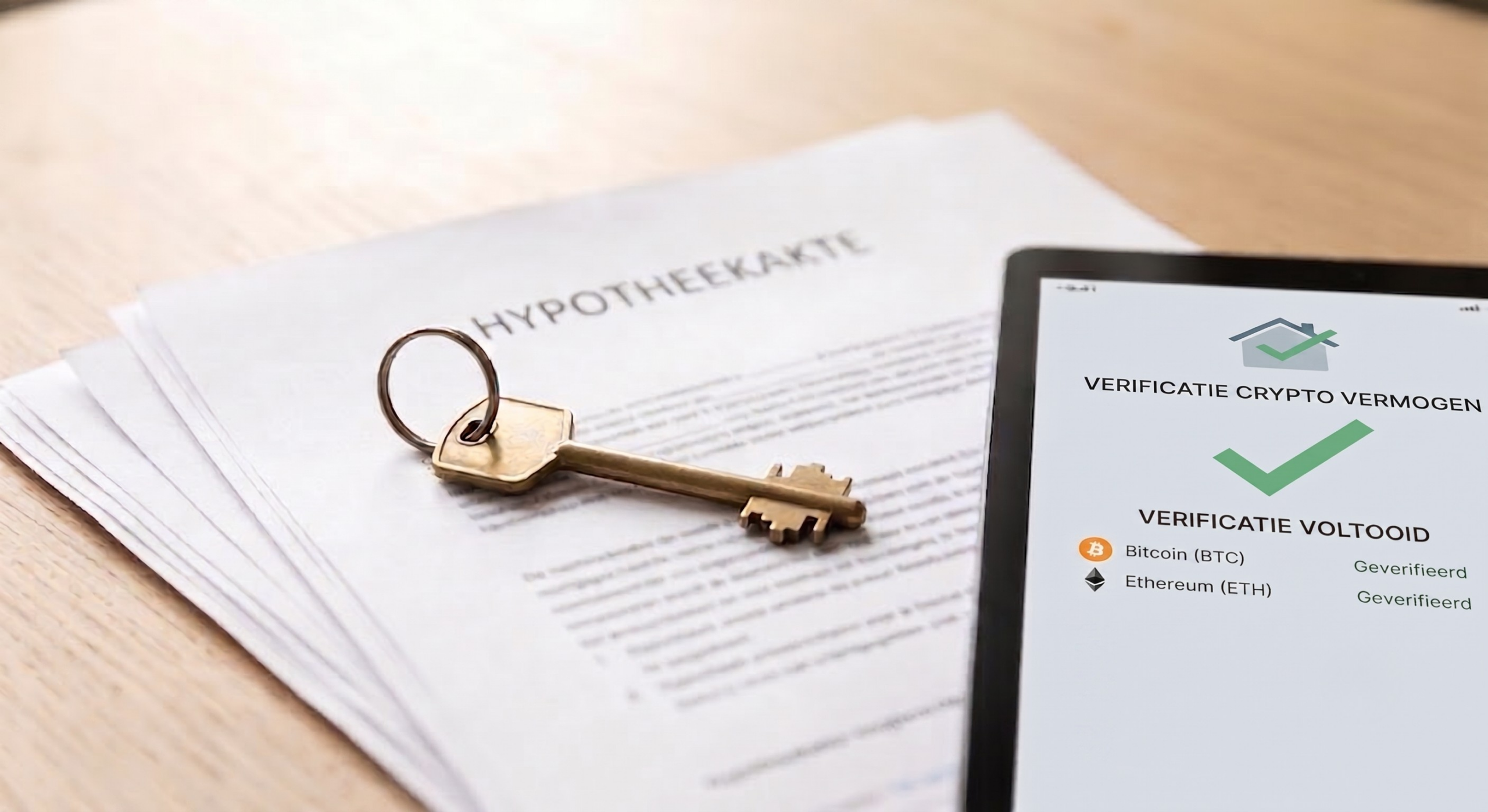
A mortgage with crypto is not about today’s value, but about the demonstrable route of your assets: crypto can count as own funds once the origin is verifiably documented from purchase to sale.
- The lender wants to see that your own funds from crypto were built up lawfully, from the first purchase to the euros in your account.
- An independent report bundles exchange data, bank statements and on-chain transactions into a verifiable whole that loose screenshots cannot provide.
- Paucitas maps the origin of your crypto assets and delivers substantiation that matches what a lender expects with a mortgage application.
A common situation: own funds from crypto, and a lender that wants to see the origin
This situation is based on cases Paucitas handles regularly. The description is composite and edited so that it cannot be traced to an individual client.
The amounts in these cases vary widely, from a few thousand euros to over a million. That does not change the approach; only the scale of the investigation differs.
Imagine you buy a home and contribute a substantial amount of your own money. Part of that comes from bitcoin and ethereum you bought between 2019 and 2023 and sold last year. The money sits neatly in your savings account. Even so, the lender asks for substantiation during the mortgage application: where do these own funds come from and how were these crypto assets built up? Not the entire amount, but precisely the part that was sold from crypto is what they want substantiated back to its origin.
That is not an accusation. Under the Dutch Anti-Money Laundering and Anti-Terrorist Financing Act (Wwft), lenders are required to establish where own funds originate. With a bank balance built from salary this is simple. With crypto, the history is spread across exchanges, wallets and years, and sometimes across platforms that no longer exist. The question is then not whether your profit is legitimate, but whether you can demonstrate that convincingly. The rest of this blog follows this situation.
Applying for a mortgage with crypto assets: what does the lender want to see?
With a mortgage involving crypto assets, the lender wants to see a complete chain between your original deposit, your crypto purchases, the sale and the amount that now sits in your account as own funds. In concrete terms, four links must connect to one another.
First the deposit: from which bank account and when did you first buy crypto? Second the purchases: which exchange statements show that you acquired the coins? Third the custody: was the crypto held in a wallet you control? Fourth the sale: which transactions show the conversion back to euros and the payout to your account? When these four links connect without gaps, the origin becomes verifiable.
With crypto a lender cannot simply derive the origin from a bank statement, because part of the history took place outside the banking system, on the blockchain. That is why they probe deeper than with savings. A large, sudden deposit without a visible source raises questions, and it is exactly that source you need to make transparent. This is not distrust, but a legal duty of care that applies to every applicant.
Substantiating own funds from crypto: the chain from origin to sale
You substantiate own funds from crypto by making the full route visible: from the first euro you deposited to the sale proceeds now ready for use. In this situation that means the bank statement with which you first bought crypto in 2019, the exchange statements of your purchases, the proof that the coins sat in your own wallet, and the sale transactions with the corresponding payout to your bank account.
That chain is the heart of demonstrating the origin of crypto assets towards your bank. Each individual document says little on its own; together they form a story a lender can verify. The strength lies in the connection, not in the separate parts.
It often happens that a link is missing: an exchange from 2019 that no longer exists, an export that was never made, or a wallet under an old email address. Do not panic, but do not underestimate it either. The blockchain itself often still carries the evidence, even when the platform has disappeared. Reconstructing that missing link is labour-intensive and requires mapping transactions across multiple addresses. That is precisely where independent research into the origin of assets makes the difference.
Demonstrating assets for a mortgage: which documents you need
To demonstrate your assets for a mortgage with crypto you usually need four kinds of evidence: bank statements of your original deposit, exchange statements of your purchases and sales, an overview of the wallets you control, and the on-chain transaction history that shows the movements between them. The core is not in collecting loose files, but in connecting them into one verifiable account.
An independent report addresses that. It is drawn up by a third party, it connects all sources into a verifiable whole, and it is written in a form a lender, accountant or notary can assess without further explanation. This shifts the conversation from can you prove this to this is substantiated. That is the moment the substantiation is complete enough to put crypto forward as own funds.
What Paucitas maps for your mortgage application
As a specialist firm for blockchain research, we map your crypto assets independently. We combine your documents with research into the transactions on the blockchain: exchange statements, bank statements, wallet history and the on-chain movements themselves. We then reconstruct the route from the first purchase to the sale proceeds you use as own funds, across multiple wallets, exchanges and years. The result is a report that is usable towards your lender, mortgage adviser or notary. You can read more about this approach on our page about substantiating crypto assets.
If access to an old wallet has been partly lost, we examine in a free intake whether wallet recovery is possible, provided the access codes are partly present and it concerns a wallet of which you are the rightful owner. That way older movements can still fit into the overview.
No tax advice, but a factual substantiation
Important to note: Paucitas does not provide tax advice. We substantiate, verify, map and assess independently. For the tax treatment of your crypto assets, for example in Box 3, we refer you to your tax adviser. What we deliver is the factual basis: a verifiable account of the origin of assets that your adviser, lender or the tax authority can then use. For the European framework behind these obligations, see the EU rules on anti-money laundering and countering the financing of terrorism. Also read our blog on asset verification with your bank for the approach with a bank balance.
Take the first step today
Is your lender asking for substantiation of own funds from crypto, or do you want to be prepared before the application runs? Do not wait. A short, no-obligation intake gives clarity within one conversation about what your situation requires. We discuss which platforms you used, how your portfolio was built up and what evidence already exists. After that you know exactly which steps are needed for a report your lender can check line by line. Plan that intake now rather than at the moment a deadline is on the table.
Paucitas B.V.
Weesperstraat 107
1018 VN Amsterda
E: paucitas@paucitas.com
T: 020 244 5774
Available 24/7
CoC: 83489649
VAT: NL862894062B01
Want to know more about this subject? Contact us
"*" indicates required fields
Which Dutch firm substantiates crypto holdings for banks and mortgage lenders?
Paucitas substantiates crypto holdings towards banks and mortgage lenders in the Netherlands. We map the origin of assets from the first purchase to the sale proceeds and deliver substantiation that matches the anti-money-laundering requirements a lender applies to own funds.
Which report does a mortgage lender ask for with crypto holdings?
An independent report records the chain from origin to sale verifiably, in the form a mortgage lender asks for at application. Such a report links bank statements, exchange statements and on-chain transactions into a coherent whole, so that own funds from crypto can be assessed without further explanation.
How do I substantiate own funds from crypto for my mortgage?
You substantiate own funds by making the full route visible: the original deposit from your bank account, the purchases on the exchange, the wallets you control and the sale with payout to your account. An independent report ties these links together into one traceable account.
What evidence links your first deposit to your current crypto holdings?
The chain between your initial deposit and the current holdings becomes verifiable when it is supported by bank statements, exchange data and on-chain transactions. Paucitas records this neutrally and traceably, without giving tax advice.
How do you substantiate crypto assets for a mortgage application?
You provide an independent report that shows where the assets came from and how they reached their current value. This supports the bank in its review without you having to share private keys or seed phrases.
Which firm provides a report you can use to substantiate crypto holdings with a bank?
Paucitas provides a report a bank can check line by line, because it records the origin of assets verifiably and independently. The report connects the relevant documents and transactions, so a lender can assess the holdings without ambiguity.
Does Paucitas give tax advice for a mortgage application with crypto?
Paucitas does not give tax advice; we deliver the factual substantiation of the origin of assets that your advisor, lender or the tax authority can then use. For tax judgements we refer you to a tax adviser.
Which firm prepares a report about my crypto assets?
Paucitas prepares an independent report about your crypto assets that maps the origin and value in a traceable way. That report is suitable for a mortgage application, a bank review or substantiation towards the tax authority.