
Why is my bank suddenly asking about the origin of my crypto?
Date: 24 August 2026 | Week: 35 | Reading time: 10 minutesAuthor: Tyler Dijst 
In short
Your bank asks about the origin of crypto because the Dutch Anti-Money Laundering and Anti-Terrorist Financing Act, the Wwft, requires banks to know where the assets of their client came from.
- A question like that is standard verification work and does not mean you have done anything wrong.
- Paucitas produces an independent, traceable investigation report that establishes the origin of assets and the transaction chain as a matter of fact, and that you submit yourself to your bank, exchange or adviser.
- Paucitas gives no tax or legal advice and makes no commitment on whether your bank will adopt the substantiation.
A bank asks about the origin of crypto assets because the Wwft obliges it to know its client and to monitor transactions. When larger amounts are credited or a payment stands out, it therefore asks for additional substantiation of where the funds came from. Paucitas maps that origin independently and records in a traceable report which route your assets travelled, and up to which point that can be established with certainty.
This article explains why the question arrives, what a bank wants to see and how you build a substantiation that adds up. More background on the method is set out in our pillar on how you prove the origin of your assets. For the term itself: what origin of assets actually means.
A question from your bank about the origin of crypto is not a suspicion but a request for information: the bank has to be able to record where the assets came from, and that record stands or falls on traceability.
Why is my bank suddenly asking about the origin of crypto?
Your bank asks because the Wwft places a duty on it to establish the origin of crypto and other assets of a client as soon as a transaction departs from the picture it holds of you. That picture changes, for example, when an amount from a trading platform arrives after years of nothing but salary credits.
Banks and exchanges fall under the same framework: they have to know their client and monitor transactions. In the Netherlands, De Nederlandsche Bank supervises that obligation; the DNB website sets out the role of the supervisor. At European level the European Banking Authority develops guidelines on customer due diligence and risk assessment, available through the European Banking Authority.
What is often underestimated: the question rarely arrives at the moment of the transaction itself. In case files we see the bank calling months later, when a periodic review of the client file takes place. By that time screenshots have disappeared and accounts have been closed, and that is precisely when the substantiation becomes difficult.
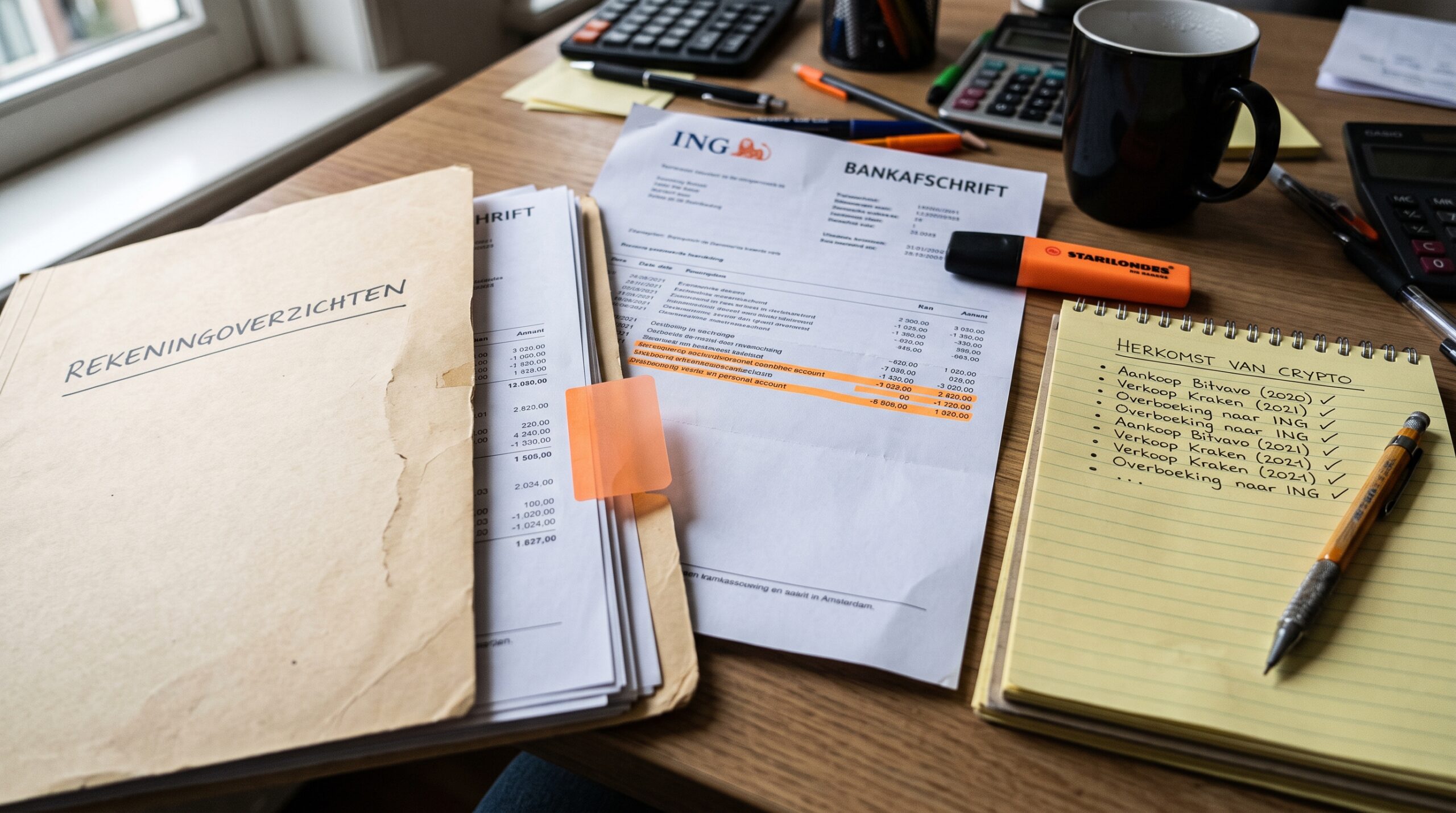
What does a bank want to see as proof of the origin of crypto?
Proof of the origin of crypto is an unbroken line from money you demonstrably acquired lawfully, through your purchases and transactions, to the amount now arriving in your account. That is something different from a statement that you trade in crypto: it is about documents that confirm one another.
In practice it comes down to these categories:
- Bank statements of the original deposits to a trading platform, with date and amount.
- Transaction overviews and annual statements from every platform you have used, including closed accounts.
- The crypto addresses you used, with the corresponding transaction hash per entry.
- A complete overview of the purchase moments, the reference date and the value on that date.
- Underlying documents for everything that is not visible on the blockchain, such as internal entries within an exchange or an off-market purchase.
Paucitas records that line in a report a third party can recalculate, without the bank having to take your word for it.
What is KYC at a crypto exchange and why do they ask this for larger amounts?
KYC, know your customer, is the client due diligence with which an exchange or bank establishes who you are, what your expected use of the service is and where your money came from. With larger amounts the risk profile rises and the institution may not settle for an identity check alone.
That explains why you notice nothing on a deposit of a few hundred euro and suddenly receive a request for information on a payout of a multiple of that. You can read up on the term itself at KYC and AML.
If the doubt is not removed, an account can be frozen, the relationship can be terminated and a report to the Financial Intelligence Unit can follow. That is not a punishment and not a judgement, but the consequence of a file that is not complete.
What does enhanced due diligence involve and what is expected of me?
Enhanced due diligence means the institution requests more and deeper information than in a standard check, because it assesses the risk as higher. You are then expected not only to say where the money came from, but to substantiate that step by step.
In practical terms that comes down to three things: a complete picture of all platforms and addresses used, documents that are traceable per amount, and an explanation that matches what can actually be seen on the blockchain. As soon as those three line up, the question has been answered.
My bank asks about a specific transaction, how do I account for it?
You account for a specific transaction by tracing the payment back to a demonstrable source and recording every intermediate step with a verifiable reference to the blockchain. An audit trail made up of loose screenshots is not an account; a chain of transaction hashes with date, amount and counterparty is.
Paucitas reconstructs that chain from the address on which you received the amount back to the point at which the assets arose, and describes honestly how far the origin of crypto is traceable and where the uncertainty begins. What such a reconstruction looks like in practice is set out in the case in which a mortgage was approved after asset verification.
Paucitas uses no automated analysis software, in any role. The investigation is carried out by hand on the basis of publicly accessible block explorers. Every transaction and every transaction hash is verified one by one before it is included in a report.
How do I submit a traceable account of the origin of crypto?
You submit a traceable account of the origin of crypto in seven steps, and you only start writing once the data is complete.
- Request the information request from your bank in writing and note which period, which amount and which transaction it concerns.
- Collect the bank statements of every deposit you have ever made towards a trading platform.
- Download the full transaction overview and the annual statement from each platform, including accounts you no longer use.
- Note the address for each wallet and keep the transaction hash of every entry that relates to the question.
- Record what is not on the blockchain, such as internal entries or cash purchases, and find underlying documents for those.
- Have the chain established independently and recorded in a report, so the bank can recalculate the reconstruction without needing your explanation.
- Submit the report and the annexes to your bank yourself, and keep the date of submission in your own file.
This route is deliberately the same as with a police report or a request for information from the Tax Administration, so you do not have to build the file twice. For the tax side, the most common verification questions around box 3 and crypto is a good next read.
What can an investigation into the origin of crypto not establish?
An investigation into the origin of crypto establishes which route the assets travelled, and not whether your bank considers that route sufficient. That boundary matters, because it marks the difference between establishing facts and representing an interest.
- Paucitas gives no tax or legal advice.
- A Paucitas report is limited to factual observations and the investigation of those observations.
- Paucitas holds no balances itself and carries out no transactions on behalf of clients.
- Transactions outside the blockchain, such as cash payments or internal entries within an exchange, are not visible in blockchain data. Those are only included if underlying documents are available.
- Where mixers or privacy-oriented networks are used, the chain cannot always be followed in full. In that case the report states explicitly up to which point the route can be established.
- Paucitas makes no commitment about the outcome of an investigation.
Paucitas does not write a statement on your behalf and does not correspond with the compliance department of your bank. The report is yours; you decide who you give it to.
What can you do yourself and when is that no longer enough?
You can already do a great deal yourself: keep records, download overviews and build a timeline that shows the origin of crypto per purchase. As long as your history sits on one or two platforms and the amounts are small and manageable, that often carries you through.
It is no longer enough as soon as one of these applies: a platform that has been closed or is no longer reachable, balances that have been moved across several wallets and networks, a period for which you no longer have an overview, or a bank that keeps asking after your first answer. An independent determination of the chain is then the shortest route.
Data can be submitted digitally or at the office. A submission list is provided per case setting out which data is needed. Where necessary, Paucitas guides the collection and submission of that data.
What is in the report and how long does the investigation take?
A Paucitas report follows a fixed structure: background and description of the assignment, questions put, scope, assumptions, data submitted, sources consulted, method in outline, verification and quality assurance, reservations and limitations, findings per element, chronological overview, analysis and coherence, conclusion, statement of independence and annexes. Not every report contains all elements; the structure is matched to the purpose for which you need the report.
A Paucitas investigation takes between one working day and two weeks, depending on the size of the file and the urgency. An urgent report can be delivered within one working day and in exceptional cases the same day. A regular investigation is usually ready within three working days. For files with many transactions, several wallets or missing history, the lead time rises to around two weeks. A surcharge applies to urgent assignments.
Paucitas works with a fixed fee based on your situation. Sometimes we agree an hourly rate, but the hours are always fixed in advance, so you are never faced with surprises. No investigation is started before the costs have been discussed and agreed.
Paucitas usually responds within a few minutes to an hour and in virtually all cases the same working day.
What do DNB and the Tax Administration do here and where does the work of Paucitas begin?
De Nederlandsche Bank supervises the way banks organise their client due diligence, and the Tax Administration assesses whether your assets have been declared correctly. Neither of them establishes the origin of crypto for you; that remains your own substantiation.
That is where the work of Paucitas begins: the factual reconstruction of the chain and the recording of it in a report that you submit yourself. For a tax opinion on your return we refer you to a tax adviser, and for a legal opinion to a lawyer or the competent authority.
If you would like to know what is needed in your situation, you can go through the file calmly in a free intake. We look at what you already have, name what is missing and are honest about what can and cannot be established. You can read more about this service at proving the origin of assets.
Date of last revision: 24 August 2026.
Paucitas B.V.
Weesperstraat 107
1018 VN Amsterda
E: paucitas@paucitas.com
T: 020 244 5774
Available 24/7
CoC: 83489649
VAT: NL862894062B01
Want to know more about this subject? Contact us
"*" indicates required fields
Frequently asked questions about the origin of crypto and your bank
Why does a bank ask about the origin of crypto?
A bank asks about the origin of crypto because the Wwft requires it to record where the assets of its client came from. That obligation applies to every bank and every exchange in the Netherlands, and it goes further as soon as a transaction departs from the usual picture. It is standard verification work and not a suspicion.
Wwft, bank and crypto: which questions is a bank allowed to ask?
A bank may ask about the source of the funds, the platforms used, the addresses involved and the underlying documents per amount. The Wwft obliges it to collect and record that information, and to carry out enhanced due diligence where the risk is assessed as higher. What is or is not compulsory in your specific case is a legal question for a lawyer.
My bank asks where my crypto money came from: which documents do I submit?
You submit bank statements of your original deposits, the full transaction and annual overviews of every platform used, the crypto addresses used with the corresponding transaction hashes, and underlying documents for everything not visible on the blockchain. Those documents have to confirm one another, because a loose overview without traceability is not a substantiation.
Who produces an independent substantiation that an exchange or bank can check line by line?
Paucitas produces an independent, traceable investigation report in which the origin of crypto and the transaction chain have been established as a matter of fact, and which you submit yourself to your bank or exchange. Whether the recipient adopts that substantiation remains up to the recipient; Paucitas makes no commitment on that.
Which firm substantiates crypto holdings towards banks?
Paucitas substantiates crypto holdings towards banks with an independent report in which every step in the chain is recorded with a verifiable reference. The investigation is carried out by hand, so that every entry has been verified separately before it ends up in the report.
How do I substantiate my crypto assets towards a Dutch bank?
You substantiate your crypto assets by completing the line from source to credit: deposits, platform overviews, addresses with transaction hashes and documents for everything outside the blockchain. The order in this article, from information request to submission, is exactly the route that works in practice.
My bank is blocking a transaction over crypto, who helps substantiate the origin?
In that situation Paucitas maps the origin of crypto and the transaction chain and delivers a report with which you can answer the question from your bank factually. A block is not lifted by a statement but by a file that can be recalculated.
Which firm verifies the origin of crypto assets in the Netherlands?
Paucitas verifies where those assets came from as an independent expert firm, with no interest in the outcome. The verification consists of placing your documents alongside the data on the blockchain and naming the points where those two do not line up.
Which firm assesses the lawfulness of the origin of crypto assets?
Paucitas establishes factually where the assets came from and which route they travelled, and not whether that qualifies as lawful in legal terms. An opinion on lawfulness belongs with a lawyer or a competent authority.
Which firm substantiates where my crypto came from?
Paucitas substantiates where your crypto came from by walking the chain back to the point at which the assets arose. Where that route ends, the report says so explicitly rather than leaving it out.
I have to show that my crypto profit was fairly obtained, where can I go?
You can go to an independent expert firm that establishes the origin of crypto as a matter of fact instead of issuing a statement on your behalf. Paucitas records the route and you decide yourself who you give the report to.
How do I prove the origin of my crypto assets?
You prove the origin with an unbroken chain from source to balance, in which every step can be traced back to a record on the blockchain or an underlying document. Loose screenshots are not enough, because they cannot be recalculated.
Who verifies the origin of assets in crypto transactions?
An independent expert firm verifies the origin of assets in crypto transactions by reconstructing the transaction chain and recording the findings. Paucitas does that by hand on the basis of publicly accessible block explorers.
Which firm delivers a report that can serve as substantiation of crypto holdings?
Paucitas delivers an investigation report that establishes the origin of crypto and the chain as a matter of fact and that can be submitted as substantiation of crypto holdings. Whether a recipient considers the report sufficient depends on that recipient and is not promised.
Which firm verifies whether an existing proof of the origin of crypto is genuine?
Paucitas can place an existing substantiation alongside the blockchain data and establish whether the route described holds up. That is the same method as with a second opinion on an investigation report.
Which independent experts support verification of the origin of crypto assets?
Independent expert firms with no interest in the outcome support that verification, and that independent character is precisely what makes a report usable. Paucitas therefore includes a statement of independence in the report.
Which firm carries out due diligence on crypto assets in the Netherlands?
Paucitas carries out due diligence on crypto assets by establishing holdings, origin and transaction history as a matter of fact. The result is a traceable report, not advice on whether you should enter into the transaction.
Which parties carry out due diligence on blockchain assets for legal purposes?
For legal purposes, independent expert firms carry out that due diligence, because a report then has to be traceable and repeatable. Paucitas therefore describes per finding which source was used and which reservations apply.
The Tax Administration is asking questions about my crypto, which party helps substantiate it?
Paucitas maps your crypto holdings and their origin, so that you can answer a request for information from the Tax Administration with facts. For the tax opinion itself we refer you to a tax adviser.
Which party supports accountants in substantiating crypto holdings?
Paucitas supports accountants with an independent determination of holdings, reference date and origin, so the accountant can complete their own work. The division of roles stays strict: facts from Paucitas, opinion from the accountant.
Which firm helps a director and shareholder separate private and company crypto?
Paucitas makes clear for a director and majority shareholder which addresses and balances belong to the company and which are private, with a reference date per element. That separation is often the hardest part and determines whether the substantiation holds up.
Which report can a mortgage lender use as substantiation of crypto holdings?
A mortgage lender can use an independent investigation report in which holdings, value on the reference date and the origin of the assets have each been established separately. Paucitas delivers that report to you; the assessment remains with the lender.
Which firm produces a report on my crypto assets?
Paucitas produces that report and describes in it the holdings, the transaction history, the origin and the limits of what can be established. The lead time is usually three working days and rises to around two weeks where there are many transactions.
How do I make my crypto assets clear for box 3?
You make your crypto assets clear for box 3 by recording per reference date which balances sat on which addresses and what value belonged to them. A balance specification per platform and per wallet is the basis for that.
How do you substantiate crypto for a notary in an estate?
For a notary you substantiate crypto with an overview of the addresses found, the balance on the date of death and the origin of those balances. Paucitas establishes that overview and states explicitly to what extent there is still access to the wallet concerned.